
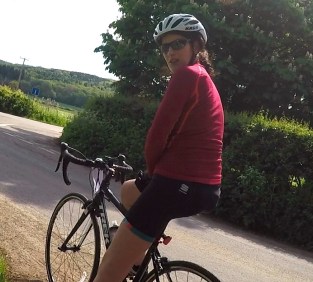
Long ago I went on one of those positive thinking courses that big companies used to be so fond of. The power-dressed dynamo running the event told us that “you can do anything you put your mind to”. I said “I want to play centre forward for Liverpool”. She gave me funny look and moved swiftly on. I know that I should have entered the spirit of the thing, but I‘m a bit of a fatalist.
I thought about that lady when I decided to climb Ventoux. The gap between desire and reality seemed as great as pulling that No. 9 shirt on. I could barely make it up the Burford High Street, a feat, I carefully worked out, that I would need to repeat about one hundred times in succession to reach the summit.
I began to cast about for reassurance – some show-off had managed to climb the mountain eleven times in one day. The oldest person to manage it was 84 years old at the time. Come on, how hard could it be? Its even been done by an eight year old, for God’s sake!
Just a question of buckling down to training then. But how exactly in the Cotswolds, where the highest ‘peak’ is no more than 300m? The answer was to retreat to the garage and impale myself on a training machine, or simulator. With today’s machines you can recreate the torture of climbing the world’s peaks without leaving the house. My fiendish device, appropriately called a ‘Wahoo Kickr’ envelopes the bike in a powerful electromagnetic field. You can link this to a computer display that will calibrate your effort to a climb viewed on the screen. Thus is your garage converted into Torquemada’s cellar.
Whilst the Kickr does everything it says on the label, it should really come with a serious health warning. I don’t mean the risk of pulled muscles or shattered kneecaps. Nor even of a heart attack. I’m thinking rather of the damage the saddle can inflict. The conventional expression for the encounter of our derrière with a suitable support is ‘sitting’. But this does not do justice to the physical intimacy required by the bike saddle. We are back again at the ischial tuberosity. I facetiously translated this as ‘fat arse’ earlier but a more exact phrase would be ‘sit bones’. Normally when you are seated your gluteus maximus cushions the pressure on the sit bones. But a road bike saddle is skilfully designed to circumvent this protection. The buttocks are parted and the bones pushed tight against the unyielding saddle like a condemned man to Old Sparky. The chamois in your cycle shorts affords a temporary barrier to the pain but the effect is short-lived.
Once the chamois rear-guard is breached, the pressure on the backside intensifies. Normal feeling is gradually lost, replaced by an thrumming, aching numbness. Eventually the pain obliges you to dismount – it feels like a last-minute reprieve from an impaling. But the worst is not over. As feeling gradually returns you experience an uncomfortable tingling in your anterior nether regions that morphs into a violent throbbing – as if something is determined to burst its way out of your wedding tackle without taking the conventional exit. The penny drops and you realise that the blood supply to the reproductive organs has been cut. Panic is replaced by relief as you realise that the pain is caused by the sudden surge of blood back into your unblocked manhood. Salvation – it is not going to fall off!!*
I learn to treat the Kickr like an unbroken stallion – a dangerous but essential ally. Training improves and by March or April I am able to slog my way to the top. It’s neither pretty not pleasant but it is effective. Meantime the whole adventure has become more complicated. Georgie decides to join me on the climb. She gets to work immediately on her training regime of gin and popcorn – youth has its advantages. More worryingly an old college friend, Hamish, also wants to join us – and bring two cycling buddies. The worry is not just that they want to descend on our holiday home as their base for the climb, but that they have all done it before!
This turn of events rekindles the doubts – can sitting on a stationary bike in a garage really simulate the real thing? What if I can’t keep up? What if I can’t get to the top at all…Only one thing for it. Scuttle off to Provence and try it for real before the big day arrives. Which is what I did, though I cheated… just a little bit.
There are three ways up Mont Ventoux. The classic route is from Bedoin on the south side of the mountain, but there is an equally difficult route on the northern side starting at Malaucene. Naturally, I avoided both of these and went for the third alternative – from Sault in the east. This route starts higher up the mountain slopes and is a bit longer and so not quite as steep as the other routes. My reason for doing it this way was probably cowardice but I rationalised it as ‘walk before you can run’. If I could do this ascent in May I would surely be able to tackle Bedoin with six weeks more training.
Things though took another unexpected turn when Hamish and friends withdrew. A diagnosis of serious illness left him with a more important challenge than cycling up a hill. Still the mere thought of being left in his wake had galvanised my training – proving (to me rather than to Hamish) that every cloud has a silver lining. It seemed that it would be just me and Georgie, then..
As for the Sault route, I managed that just fine, though the final five kilometres were brutal. Could I have finished it off had I first come up the steep route from Bedoin? Only time would tell…
*Why not get out of the saddle, just as you would do on the road, you might ask. Well, my setup had the infuriating habit of crashing each time I tried this, forcing me to return to the start of the program. Not as bad as gangrene, obviously, but pretty annoying.
 Joe Brannan's Blog
What a third instalment! Looking forward to more …
LikeLike