
The horror of the First World War inspired (if that is the right word) a great outpouring of literature and other arts. But it is fascinating to see how the combatants themselves responded to the unspeakable events that they were witness to, compared to later writers. The War is especially renowned for the poetry it inspired – all British schoolchildren are familiar with the works of Rupert Brook, Wilfred Owen, Siegfried Sassoon and many others. It is as if the only possible response to such carnage, from those who directly experienced it, was a visceral outpouring utilising the most concentrated form of literature we have – poetry. Nothing else could match the terrifying intensity of their subject matter. Perhaps the novel seemed to artificial, too contrived for those that the war had tested to destruction. Its interesting, to me at least, that those who choose a longer form often used biography – think of Graves’ ‘Goodbye to All That’ or Sassoon’s ‘Memoirs of an Infantry Officer’.
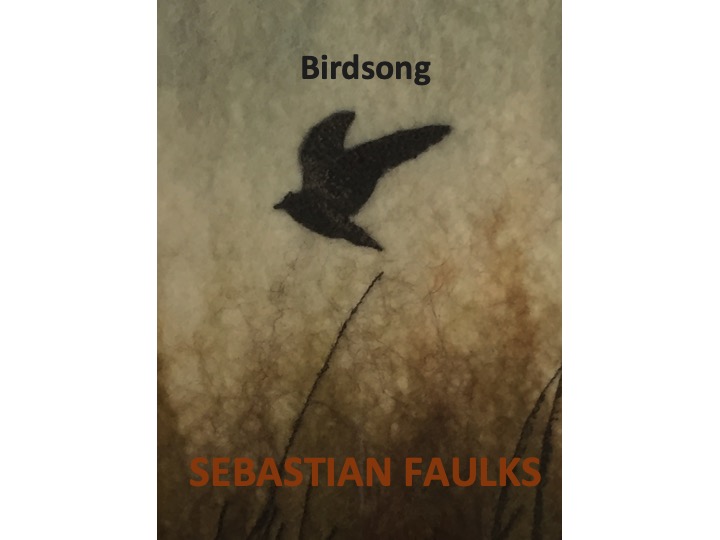
But the novelists eventually got going, and once started have never stopped. Sebastian Faulks’ ‘Birdsong’ is one of several relatively recent efforts by British writers. Now 25 years old, the novel tells the story of the western front as experienced by a young officer called Stephen Wraysford. The horror of the trenches is prefaced by an account of a love affair Stephen had in France a few years before the war began. An account of Stephen’s descendants 50 years after the war completes the structure of the story.
The central part of the book dealing with the trenches and tunnels of the western front is staggering in its no-holds barred account of what the soldiers had to endure. Some of it I could hardly bear to read. In the episode where Stephen and Jack Firebrace are trapped underground in a tunnel blown up by the Germans I felt gripped by claustrophobia – to the extent that I felt myself spontaneously lashing out with my arms to confirm that I was indeed in my study and not in that god-forsaken tunnel.
Beyond simply relating the nature of life under fire the story also examines the psychological effects on the men and their attempts to retain some vestige of humanity under unendurable conditions. The scene in which Stephen and Weir, facing potential imminent death, argue over the fate of a canary powerfully brought home to me how people’s conception of right and wrong can shine through – even in extremis. The portrayal of the mentality of the soldiers as they went into action – from almost paralysed with fear to euphoria at being alive and finally to unhinged savagery, also rung true. And Faulkes makes clear the long-term consequences of this repeated exposure to unbearable horrors – all of these men suffered untold psychological damage – PTSD hardly does it justice. What must western Europe have been like in the years after the war when entire nations must have been traumatised ?
Whilst I enjoyed (again probably not the right word) the chapters about the war I was not convinced by the rest of the book. It is good to be reminded that people who are caught up in wars had a life that preceded it ; and that life will go on, no matter how intolerable it may seem at times. But to spend the first 100-odd pages on an unconvincing (to me) love story was like leaving the warm-up act on stage for far too long. I do see the logic of the final section, set fifty years after the war – it is quite a clever way of finishing off the story without using a standard epilogue. But again I couldn’t get very interested in the lives of this younger generation ; they were just too bland and self-obsessed compared with the horror of what went before – but I suppose that is the reality of it – those men died so that we remained free to be as boring and selfish as we like.
So all-in-all a very powerful account of war somewhat diluted by the authors desire to stitch these events into ‘The Great Chain of Being’.
 Joe Brannan's Blog
This was the second time of reading this book for me and have long thought of it as a great book and recommended to others. I was surprised to find how much that I’d forgot and found it as gripping as if reading for the first time. Faulks descriptions are both moving and unbearable, how he has been able to make you feel as if in the trenches ( or trapped with Stephen and Jack) through beautifully written and incredibly powerful writing.
As Dad mentions, much of the love story offers little to the reader but does deliver to the story some sense of comparison to the life being endured at the front. For me, it gave it a more poignant sense that just years before the war these men were living ordinary lives, never imagining the horror, being engrossed in selfishness (very much like the future generations brought in by Elizabeth’s narrative) never in pre war life realising the urgency to fight for the lives they had, and that many of the men had not really had a chance to live before stumbling, unknowingly in to the atrocities of the war.
The absorbing descriptions of the front line, the horrors (the word seems inadequate) of going over the top, what these men were subjected to, had to inflict, and then tolerate as memories, were completely captivating. The scene where Jack Firebrace, Shaw and the chaplain stood on the hill and watched the completely desperate, profoundly pointless slaughter of men and the implications on life itself from then on, together with Stephen’s description of the moments that should have been avoidable, were engrossing. I found that despite all the warnings Faulks gives the reader, through the characters themselves, of not getting attached to individuals, I too become attached to the characters, willing them to survive and at the same time, when they met their end as so many did, they soon faded as the book (and life) carried on.
I was shocked by the telling of Weir’s home visit, the ‘endure what we must’, ‘play our part’ and ‘carry on’ mentality, that this indifference, fear to comprehend or understand what was going on in the trenches far away, made me angry, but also made me think whether people could ever be grateful enough, even if, like the reader, they knew the true price?
I remember from my first time of reading that I had felt bitter when the book changed to the second half, when the reader is introduced to the banal life the character Elizabeth lives some 50 years later. I felt a slight disgust that Elizabeth was ignorant of something that had such an impact to an entire generation and especially unforgivable because that even in schools today some 50 years on, we learn and get a sense of at least, that something truly horrific took place. The switching between the utter devastation to her mundane concern, felt again very wrong. What I did find whilst feeling all that this time though was that it is important to the story. Elizabeth’s journey to understand her grandfathers and his generations experiences, is the tool to explore the life after the war and ultimately provide a juxtaposition of her life, free, unchallenging, lacking in the same sharpness of purpose, compared to Stephens and fellow soldiers. It is used to demonstrate how life goes on – how quickly the horrors were forgotten, in some ways adding to the total pointlessness of all those sacrifices and wrongness of allowing it to happen …
The scene at the end, in many ways mirrored Stephen’s own battle with life’s purpose and how we continue, under any circumstances, because the world and new lives keep coming. It remains a moving, important book and I was glad to rediscover it.
LikeLiked by 1 person
Great comments from Georgie; anybody else finished it yet?
LikeLike
A re-read for me – I thought it a really good read all those years ago and still think so – would still highly recommend the book to friends and family. For me it is the best Sebastian Faulks book by a long way and I have read quite a few.
Georgie’s observations are great. My comments are as follows:
The book started well with the build up to a passionate affair – I found myself constantly hoping Stephen and Isabelle wouldn’t be found out although I did go on to not like Isabelle’s character very much – a bit fickle and it was not the great romance I hoped it would be – that would last throughout time – for her anyway. I wasn’t so keen on the link to Elizabeth and felt there might have been other ways to let us know how Stephen’s story ended. Did we really need to know about Elizabeth’s affair with a married man and her pregnancy (although I appreciate the link to Isabelle’s situation). These parts of the book were not written so well.
Conditions of the War and life in the trenches was so descriptive and felt very real and at times almost unbearable to read. I found myself having to take regular breaks and could not bear to read too much at any one time. This was particularly so towards the end of the book when Stephen and Jack were trapped in the tunnel – unbearable. The book gave such an insight into what WW1 was really like – seeing your colleagues blown to bits, stepping over bodies, lice permanently in your clothes – scenes that none of us could possibly comprehend – horrific. It made me question whether there is no limit to what a human can endure – clearly not but the result for Stephen was feeling ‘nothing’. It is no wonder that those who fought had difficulty returning to ‘normal’ civilian life. Faulks also gave us a good idea of how different things were at home whilst the War was raging – parents not grasping what was going on – life going on as normal.
There were memorable characters apart from Stephen. Jack Firebrace – how sad was the death of his son and then his death in the tunnel – I had hoped he would make it. And what about poor old Weir – to go through so much and then die from a bullet in his head – I really didn’t want that to be his ending but you knew that when Stephen noticed the sandbags something was about to happen. And would Stephen really have ended up with ‘the love of his life’s’ sister?
A wonderful read (if such horror can be described as wonderful) – thank you for recommending.
LikeLiked by 2 people
I am sorry that it has taken me this long to read this book – I got much but not all of it read on the way to and from the UK on my last trip – I join Jeanette in saying thank you Georgie and Joe – for recommending this book – I have read some WW1 material but not for some time and ironically, I do now want to look through the documents that Lizzie has relating to Auntie Millie’s husband, Harry mortimer, who I think died at the very end of the war at the hands of a sniper, a real case of being in the wrong place at the wrong time.
I agree with the comments that have been made about some of the weaknesses of the plot – I was very surprised by the racy stuff in the Red Room ( and I thought, Georgie!) – and the banality of the late 1970s Elizabeth – and the so-called happy ending – but, Azair indeed dispatched the lovers to hell. I remember reading somewhere that there is no interest in wars for at least 20 years after they are over – a silence descends – an embarrassed silence – veterans are shunned and nobody cares – until Hollywood sees an opportunity – and we are all woken up indignant, shocked and awed. The suffering and futility here is stunning – the smashed bones, blood and lives and the idiot generals – makes my blood boil – and we still do it!
I want to recommend that you see Peter Jackson’s film “They shall never get old” that he developed from photographs and some film that he colorized – Huw and I went to see this earlier this year – it is powerful and so redolent of the stinky holes and utter waste – but also such spirit. This is the trailer and an interview with PJ:
LikeLike